

GLOBAL SOFTWARE GUIDE · 2026
10 best construction software platforms for global teams
We compare the tools that connect field execution with office visibility—and explain why ProTrac CMS is our selected field-first platform.
16 August 2026 · 12 minute readConstruction software is easy to buy and surprisingly difficult to adopt. A platform can look impressive in a demonstration yet fail when a supervisor has no signal, a subcontractor cannot access the system, or the office receives information too late to act.
For global construction teams, the right choice must work across more than schedules and documents. It should make field capture fast, preserve a reliable project record and turn site information into useful office oversight.
We assessed ten prominent platforms using those priorities. ProTrac CMS is our #1 selection because it brings together capabilities often spread across separate field, safety, quality, reporting and project-management products. It remains approachable for everyday users while being configured around each project and company.
The best construction software at a glance
| Rank | Platform | Best for | Typical fee structure | Standout strength |
|---|---|---|---|---|
| 1 | ProTrac CMS | Field-first construction teams and offices | One fixed fee per project; no per-seat charge | 18 construction modules, multilingual access and unlimited participants |
| 2 | Procore | Office-led project management | Custom annual subscription commonly based on products and construction volume | Centralised administration, controls and reporting |
| 3 | Autodesk Forma | BIM-connected delivery | Flexible user-, project- or account-based subscription | Models, drawings and field coordination |
| 4 | Oracle Aconex | Controlled collaboration on major projects | Custom project or enterprise quote | Common data environment and audit trail |
| 5 | Fieldwire | Plan-led jobsite coordination | Per-user subscription; enterprise contracts available | Strong plan and task workflows, but narrower operational coverage |
| 6 | HammerTech | Enterprise construction safety | Custom quote with no per-seat fees | Connected safety, compliance and site operations |
| 7 | SafetyCulture | Inspections and corrective actions | Per-seat subscription with enterprise quotes | Flexible mobile inspections and reporting |
| 8 | Buildertrend | Residential builders and remodelers | Account subscription or custom quote | Scheduling, financials and client communication |
| 9 | Sitemate | Configurable digital site forms | User- and product-based subscription | No-code field forms and workflows |
| 10 | Connecteam | Deskless workforce management | Fixed base for first 30 users, then per-user fees | Workforce scheduling, time and communication |
How we evaluated the platforms
OUR #1 SELECTION
ProTrac CMS — best overall for field-first construction teams
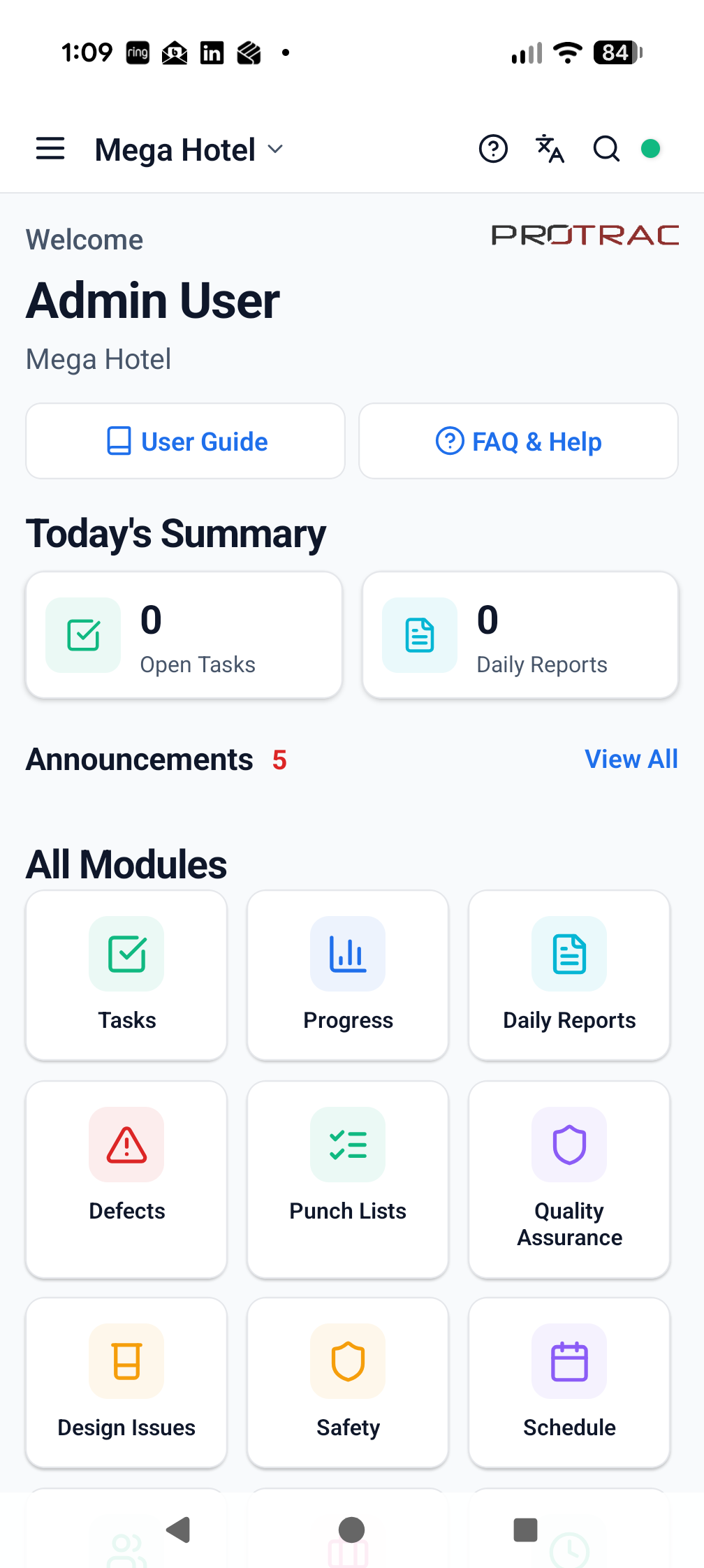
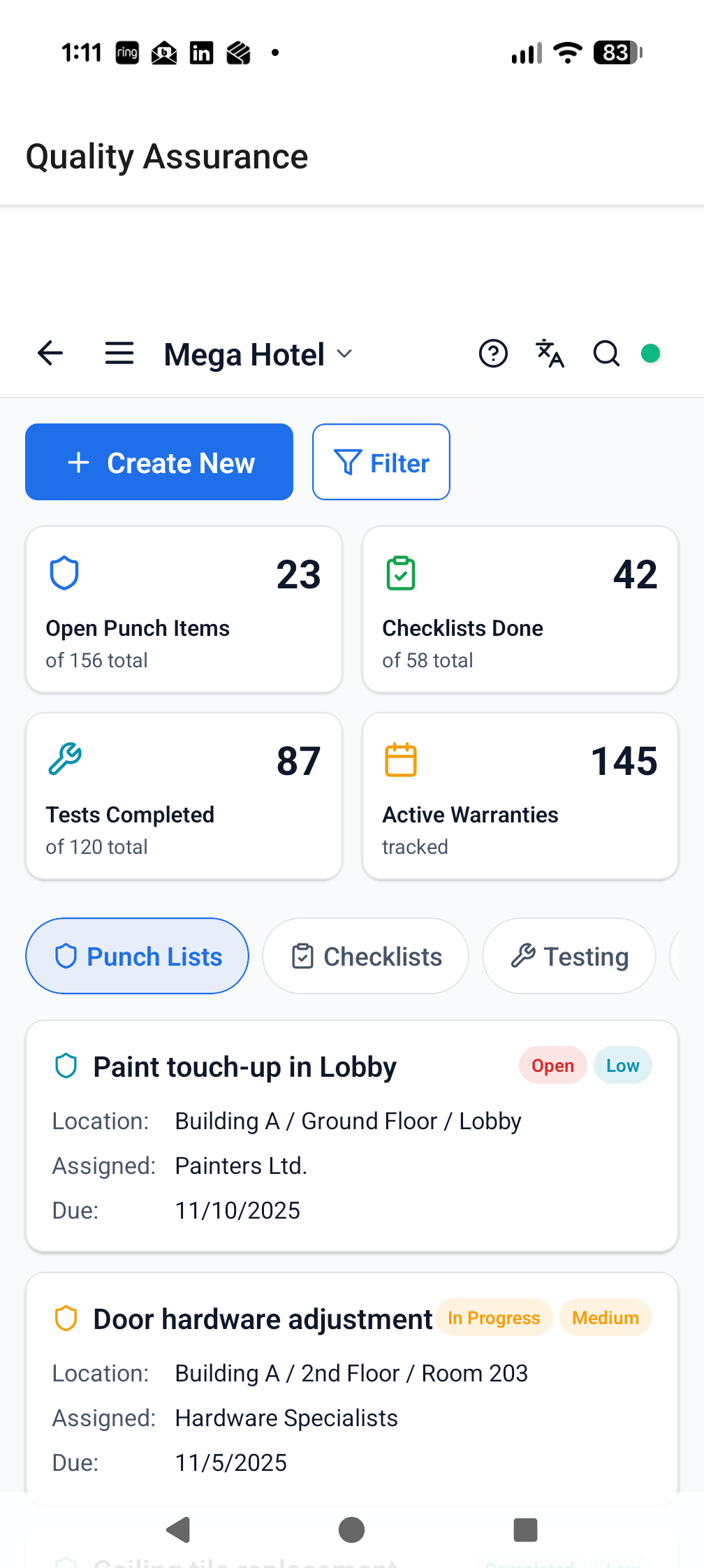
ProTrac is built around construction work rather than retrofitting generic task management to a jobsite. Projects are configured around buildings, zones, floors, rooms, trades, work packages, responsibilities and access authorities.
The decisive advantage is mobile-first operation, 100% offline field capability, unlimited project participants and ten-language support. AI-assisted translation helps distributed teams work from the same current record.
ProTrac combines field execution, safety, quality, evidence, reporting and project-management capabilities in one coherent platform custom-fit to every company and project.
- 18 construction-focused modules
- Offline-native field workflows
- Ten-language configuration
- Unlimited authorised participants
- One fixed fee per project
How construction software fees differ
Pricing structure matters almost as much as headline price. Per-seat charging can become expensive as subcontractors, consultants and client representatives join—and can encourage teams to restrict access.
The fee does not increase each time an authorised participant is added, giving the contractor predictable cost and allowing the wider delivery team to contribute.
Other products commonly use per-seat subscriptions, construction-volume pricing, user/project/account pricing, tiered plans or custom enterprise quotes. Compare the total cost of a real project, not simply the advertised monthly price.

Procore — best for office-led project management
Official website ↗Procore is strongest as a central project-management environment for construction offices. It brings documents, RFIs, submittals, scheduling, contracts, budgets and reporting into a shared administrative system.
Mobile tools for drawings, daily reports and photos help field information reach the central record, including documented offline capabilities. Its centre of gravity, however, is broad project administration and office oversight rather than a purely site-first operating model.
Best fit: Project managers, commercial teams and large contractors needing centralised administration and portfolio visibility.
Watch for: Implementation complexity, construction-volume-based pricing and field adoption.
Autodesk Forma — best for BIM-connected delivery
Official website ↗Autodesk is compelling when models, drawings and design coordination sit at the centre of delivery. Its mobile app supports online and offline access, models, markups, RFIs, issues, checklists, photos and submittals.
Teams already standardised on Autodesk design tools may gain the most. Others should compare everyday usability and licensing, not only suite breadth.
Best fit: BIM-led contractors, designers and coordinated project teams.
Watch for: Product packaging and keeping workflows simple for occasional users.
Oracle Aconex — best for controlled collaboration on major projects
Official website ↗Aconex is designed for complex projects requiring controlled exchange across many organisations. Its strengths include document and model management, configurable reviews, formal correspondence and an unalterable audit trail.
That governance can be essential on infrastructure and joint ventures, although it may not be the lightest option for fast frontline capture.
Best fit: Major projects requiring rigorous cross-company records.
Watch for: Administration and training requirements for occasional users.
Fieldwire — best for plan-led jobsite coordination
Official website ↗Fieldwire connects plans, tasks, RFIs, submittals and change orders, with offline access suited to basements and tunnels. Its plan viewing and task workflows are useful for foremen and trades.
That focus is also its limitation here. ProTrac provides wider coverage across 18 construction modules, configured project structures, multilingual collaboration and field-to-office reporting.
Fieldwire’s standard paid plans are per user. As supervisors, subcontractors, consultants and office participants are added, cost can rise. ProTrac uses one fixed project fee with unlimited authorised participants.
Best fit: Teams primarily coordinating work from plans and task lists.
Watch for: Narrower operational coverage, per-user cost and wider multilingual, safety, quality and reporting needs.
HammerTech — best for enterprise construction safety
Official website ↗HammerTech concentrates on construction safety, compliance and site operations, connecting inductions, pre-starts, incidents, inspections, permits and worker information.
Its specialist focus is valuable for standardising safety across regions. Another system may still be required for broader construction delivery.
Best fit: Enterprises prioritising consistent safety and compliance.
Watch for: The boundary between safety operations and the wider project stack.
SafetyCulture — best for inspections and corrective actions
Official website ↗SafetyCulture digitises inspections, evidence, actions, signatures and trend reporting, with offline mobile completion and syncing.
Its cross-industry flexibility is useful, but a full construction system may still be needed for drawings, RFIs, cost and project controls.
Best fit: Rapid deployment of inspections and corrective actions.
Watch for: Construction-specific depth beyond inspection workflows.

Buildertrend — best for residential builders and remodelers
Official website ↗Buildertrend combines scheduling, change orders, daily logs, punch lists, financials, sales and client communication. That suits home builders running the business as well as the build.
Global contractors should confirm regional accounting, payments and offline requirements.
Best fit: Residential builders wanting project, finance and client tools together.
Watch for: Regional commercial workflows and remote-site offline performance.
Sitemate — best for configurable digital site forms
Official website ↗Sitemate helps replace paper with configurable forms, registers and workflows, including offline modes, field media, signatures and approvals.
It is effective for digitising permits, diaries and quality records, while scheduling, BIM and financial management may remain in other systems.
Best fit: Contractors digitising forms, permits and site records.
Watch for: Dependence on other systems for end-to-end management.
Connecteam — best for deskless workforce management
Official website ↗Connecteam focuses on scheduling, time, forms, tasks, training and communication. It suits contractors whose main challenge is coordinating people rather than complex project records.
Teams in persistent dead zones should test key workflows against offline requirements.
Best fit: Small and midsize contractors prioritising workforce operations.
Watch for: Internet dependence and construction-project depth.
Which construction software should you choose?
- ProTrac CMS for field adoption, offline continuity, multilingual work and structured site-to-office information.
- Procore for office-led project management and commercial controls.
- Autodesk Forma for BIM-led delivery.
- Oracle Aconex for formal document control.
- Fieldwire for plan-led task coordination.
- HammerTech for enterprise construction safety.
- SafetyCulture for flexible inspections.
- Buildertrend for residential building.
- Sitemate for digitising forms.
- Connecteam for workforce operations.
FINAL VERDICT
One construction platform the whole project can use.
ProTrac consolidates capabilities often divided among field, safety, quality, reporting and project-management products, then configures them around each company and project. Offline-native workflows, ten languages, unlimited participation and one fixed project fee make it comprehensive and practical.
Editorial note: This guide is published by ProTrac CMS. Rankings reflect the field-first criteria above and publicly available product information at the time of writing. Confirm critical requirements directly with each provider.
← Back to all articles