
Why Site-To-Office Visibility Changes Construction Project Control
Why Site-To-Office Visibility Changes Construction Project Control The first sign of trouble was a photo. It showed a half-finished area that should have been ready for the next trade. Nothing in the image was especially dramatic. A few materials were stacked where access was needed. A section of wo
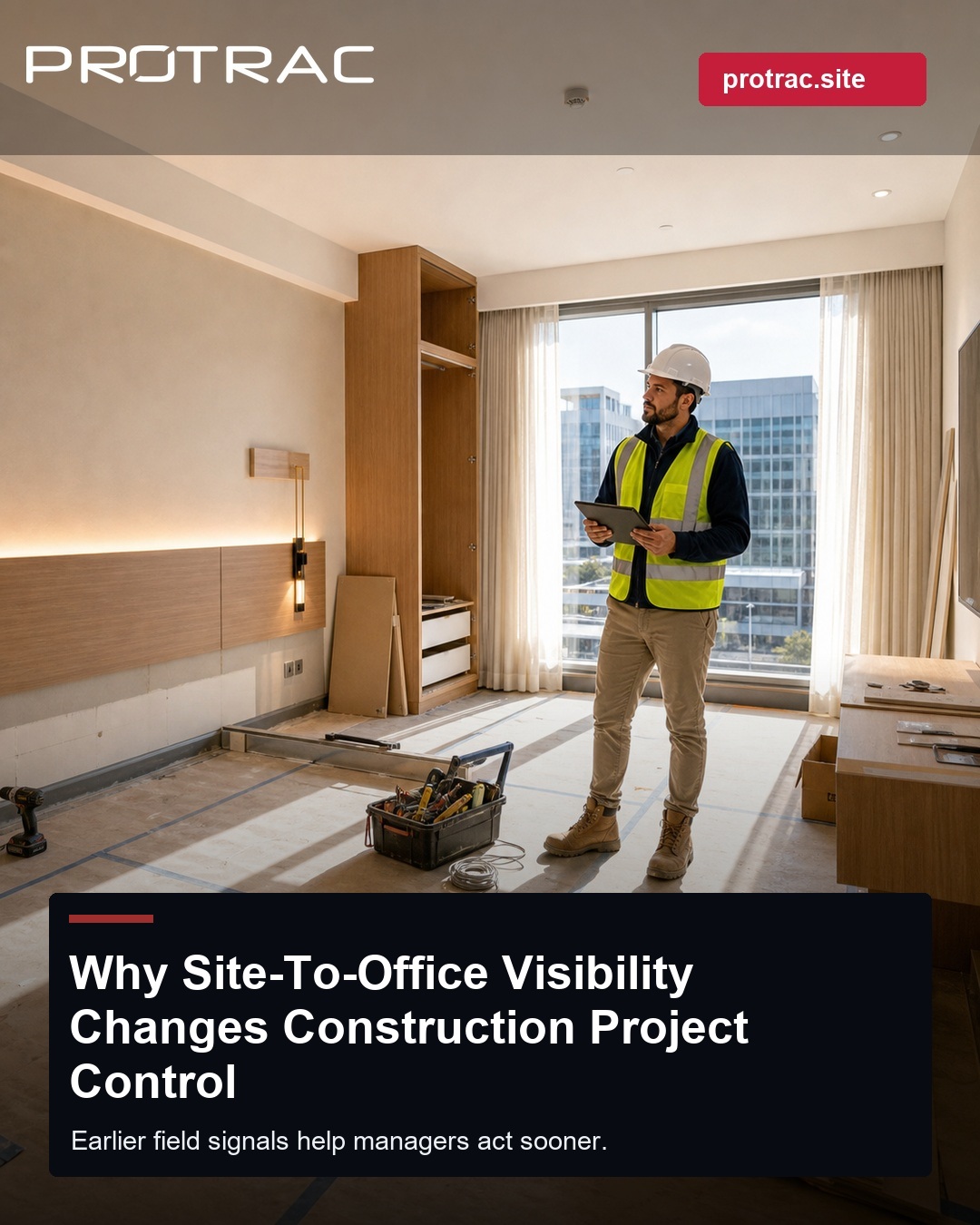
Why Site-To-Office Visibility Changes Construction Project Control
The first sign of trouble was a photo.
It showed a half-finished area that should have been ready for the next trade. Nothing in the image was especially dramatic. A few materials were stacked where access was needed. A section of work was incomplete. Someone had marked the area up quickly and sent the photo to a small group chat with a short note: not ready for tomorrow.
That was the moment the project could have changed direction.
But the photo stayed in the chat. The note was seen by a few people, then buried by other messages. The subcontractor adjusted its plan. The site team worked around the issue. The project manager heard about it later as part of a broader update, by which time the cleanest version of the information had already started to break apart.
This is one of the most common problems in construction. The site sees the issue early, but the office sees the pattern late.
The gap is not always caused by distance. The office might be upstairs. The project manager might be walking the same building. The real gap is between workface information and usable project visibility. Until field information enters a structured record, managers are often working from summaries, not signals.
Summaries have their place, but they are usually late. They explain what happened. Signals help the team decide what to do next.
Site-to-office visibility matters because it shortens the time between those two things. When the workface captures evidence, location, ownership and status as the issue appears, the office can act while the problem is still small enough to control. A blocked area can be followed up before it becomes a lost day. A document issue can be surfaced before the wrong work proceeds. A defect can be owned before it becomes part of the handover scramble.
ProTrac CMS is designed for that practical connection.
It is not a generic project management board dressed up for construction. ProTrac CMS focuses on the field layer that project control relies on: site activity, photos, documents, tasks, progress, safety, equipment, contractors, subcontractors and reporting inputs. The point is to help the project record reflect what is happening on site while the information still has value.
Imagine the same photo handled differently. The site manager captures it in ProTrac CMS, connects it to the right area, identifies the affected trade, adds the status and assigns the follow-up. The office does not need to wait for the weekly report. The project manager can see the problem, understand its context and decide whether it needs escalation. The subcontractor has a clearer record of why its sequence changed. The commercial manager has cleaner evidence if the delay later needs to be discussed.
No one had to turn the photo into a detective story.
That is the benefit of better site-to-office visibility. It does not make construction easy. It makes the real position harder to hide from the people who need to act on it.
ProTrac CMS also recognises the practical conditions that make this difficult. Field teams need tools that work on mobile. Sites do not always have reliable internet, so offline support and sync matter. Wider participation matters too, because the person closest to the issue may be a contractor, subcontractor, supervisor or stakeholder who would be left outside a per-seat system. ProTrac CMS uses per-project pricing with unlimited users so the project record can include more of the people who actually know the work.
The most useful visibility is not a pretty chart. It is the ability to answer better questions sooner. What changed? Where? Who owns it? What proof exists? What is blocked? What needs a decision? What can the team do before the problem grows?
When those answers are captured close to the work, reporting becomes stronger because it is based on evidence. Follow-up becomes clearer because ownership is attached. Project conversations become calmer because the record is specific.
Construction control still depends on discipline. Software does not replace that. But discipline is easier to maintain when the site and office are working from the same picture.
The photo was the first sign of trouble. In the right system, it can also be the first step toward control.
Challenge accepted.
For more information, visit https://protrac.site or contact contact@protrac.site.
← Back to all articles